


Buying a temperature transmitter looks simple until the units arrive. The datasheet said “±0.1%,” the sensor list looked complete, the price was good. Then commissioning finds the protection rating doesn’t suit the location, the isolated version costs extra and nobody quoted it, and the cold-junction error eats half your loop budget. None of that is fraud. It’s the gap between what a buyer reads and what a spec sheet actually commits to.
This is a checklist for procurement and project leads evaluating an analog (4–20 mA) temperature transmitter supply, written around the line items that cause change orders and rework later.
1. Confirm the form factor matches the install, before price
Head-mounted and DIN-rail transmitters are not interchangeable on site, and switching late means re-specifying enclosures or cabinet space. A head-mounted unit drops into a sensor connection head at the measuring point. A DIN-rail unit lives in a cabinet or marshalling box. Some product lines cover both from one family, which keeps spares and configuration consistent across a plant. Ask the supplier to confirm the exact model code for each location, not just the family name.
2. Isolation is usually a paid option, not a default
This is the most common quiet cost. Many transmitters ship in a non-isolated base version, with electrical isolation available as a separate variant at a higher line item. On loops that share grounding paths, run long cable, or sit near drives and high-power equipment, isolation is normally worth specifying. The mistake is discovering at commissioning that the quoted units were the non-isolated variant. Make the supplier state the isolation rating and the model suffix on the quote, in writing.
3. Read the protection rating as enclosure-dependent
A module-level IP rating describes the module, not your installation. A housing rated to a modest ingress level still needs a field enclosure to provide real protection in a washdown, dusty, or outdoor location. If a supplier markets a low-cost transmitter for a harsh location without addressing the enclosure, that is a flag. The ingress protection your site needs has to come from somewhere, and it is a cost either way.
4. Make the accuracy claim concrete
“±0.1%” alone is not a commitment you can hold a supplier to. A defensible accuracy spec states three things, and you should ask for all three:
- The reference condition the figure was measured at (a typical bench condition is 20 °C ± 2 °C ambient). Anything outside that band brings in drift.
- The temperature drift coefficient, in °C per °C of ambient change, per input type. A transmitter on a sunny pipe rack sees large ambient swings, and that drift adds directly to field error.
- For thermocouple inputs, the internal cold-junction compensation error, which must be added on top of the base accuracy. On tight thermocouple loops this term can dominate.
If a quote gives you only the headline number, that is not enough to write into a spec.
5. Match the input list to your sensor inventory
Confirm the device accepts the specific RTD and thermocouple types your plant already uses (Pt100, Cu50, and the thermocouple letters B, E, J, K, N, R, S, T are a common set), plus the wiring method (2-wire, 3-wire). A mismatch here means buying new sensors or new transmitters, not a small change.
6. Treat supplier sourcing and OEM capability as a procurement variable
For volume buys, replacements over a plant’s life, or private-label needs, the questions are about the supplier as much as the product: Can they support OEM or custom configuration? What is the lead time and minimum order? Is there a documented quality system (for example ISO 9001) behind the production line? A supplier that can answer these in writing is a different risk profile than a catalog reseller.
A worked example of the spec lines above
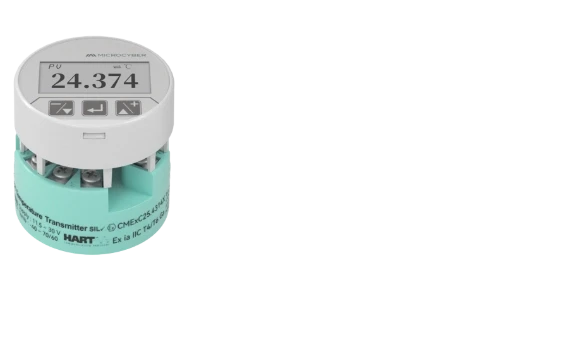
One example of an analog transmitter in this class is the NCS-TT106A series from Microcyber, a manufacturer based in Shenyang, China. Its published specification illustrates the exact line items a buyer should be checking:
| Procurement check | What the spec states |
|---|---|
| Form factors | Head-mounted (NCS-TT106A) and DIN-rail mounted (NCS-TT106A-R1) in one family |
| Isolation | 1500 VAC isolated, or a non-isolated version (suffix N) — a variant choice |
| Protection | Terminals IP00, housing IP40 — enclosure-dependent |
| Reference condition | Accuracy measured at 20 °C ± 2 °C ambient |
| RTD accuracy | Pt100: ±0.1% of range or ±0.2 °C, whichever is larger |
| Temperature drift | Pt100: ±0.005 °C/°C |
| Cold-junction error | Internal ≤ ±1 °C, added to thermocouple accuracy |
| Sensor inputs | RTD: Pt100, Cu50 (2-wire, 3-wire); TC: B, E, J, K, N, R, S, T |
| Output / power | 4–20 mA / 12–40 VDC |
| Operating temp | −40 to 80 °C |
| Manufacturer quality system | ISO 9001 certified (per manufacturer) |
The point is not that one model wins. It is that a supplier should be able to hand you every row above for whatever they quote. If they can, you can build an honest accuracy budget and avoid the variant and enclosure surprises. If they can’t, you have your answer.
For project specs, the NCS-TT106A user manual lists the full per-sensor ranges, minimum spans, and drift coefficients. Request the manual, datasheet, and a model-code quote at info@microcyber.cn. Product page: https://www.microcybers.com/en/head-mounted-1-ch-4-20ma-temperature-transmitter/.