


If you’ve searched “What is a temperature transmitter with HART?”, “What is HART in transmitter?”, “What is the difference between 4/20mA and HART?”, “What is the smart HART temperature transmitter?”, or “What are the 4 types of temperature sensors?”, you’re not alone. These are some of the most common questions engineers, technicians, and procurement teams ask when evaluating process instrumentation.
In this complete 2026 guide, we answer every question clearly and practically. You’ll learn exactly what HART is, how it works inside a temperature transmitter, why smart HART transmitters are now the industry standard, the real difference between classic 4-20mA and HART, and the four primary types of temperature sensors used today. We’ll also use the Microcyber NCS-TT106H as a real-world example of a modern smart HART temperature transmitter.
What is a Temperature Transmitter with HART?
A temperature transmitter with HART is an intelligent field device that converts the raw signal from a temperature sensor (RTD or thermocouple) into a standardized 4-20mA analog signal while simultaneously enabling two-way digital communication using the HART protocol.
Unlike a simple temperature sensor that only outputs a weak mV or resistance signal, a HART temperature transmitter does three things at once:
- Measures temperature accurately
- Converts the signal to a reliable 4-20mA current loop that DCS/PLC systems understand
- Allows digital communication (configuration, diagnostics, and data) over the same two wires
This makes it “smart” — you can install it in a remote, harsh industrial environment (oil & gas, chemical plants, power stations, metallurgy) and still configure or diagnose it from the control room without running extra cables.
What is HART in a Transmitter?
HART stands for Highway Addressable Remote Transducer. It is an open communication protocol developed in the 1980s that has become the global standard for smart process instruments.
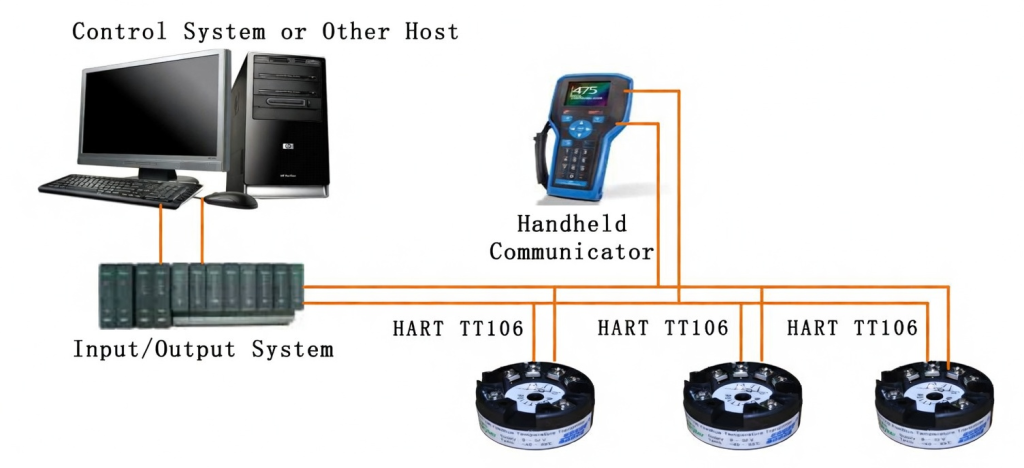
Think of HART as a “digital overlay” on top of the traditional 4-20mA analog signal. It works by superimposing low-level digital signals (using Frequency Shift Keying — FSK) onto the same two wires that carry the 4-20mA analog current. This means:
- The analog 4-20mA signal continues to work exactly as before
- You can send and receive digital commands (read PV, change range, perform diagnostics) at the same time
HART is backward-compatible, vendor-neutral, and supported by virtually every major DCS and PLC system in the world.
What is the Difference Between 4-20mA and HART?
This is one of the most frequently asked questions. Here’s the clear breakdown:
| Feature | Traditional 4-20mA | HART (on top of 4-20mA) |
|---|---|---|
| Signal Type | Analog only | Analog + Digital (simultaneous) |
| Information Carried | Only one variable (temperature) | Multiple variables + diagnostics + configuration |
| Communication Direction | One-way (field to control room) | Two-way (read & write) |
| Configuration | Requires loop calibrator or manual adjustment | Remote configuration with handheld or software |
| Diagnostics | None | Full device diagnostics, sensor fault detection |
| Max Devices per Loop | 1 | Up to 64 in multidrop (digital-only) mode |
| Current in Digital Mode | 4-20mA varies | Fixed at 4mA (pure digital) |
In short: 4-20mA is the reliable analog “highway”. HART is the digital “smartphone” riding on the same highway. Modern plants use both together — the analog for fast control, HART for intelligence.
What is a Smart HART Temperature Transmitter?
A smart HART temperature transmitter is the next-generation version of a classic transmitter. It contains a microprocessor that performs:
- Linearization and cold-junction compensation for thermocouples
- Lead-wire compensation for RTDs
- Digital filtering and damping (0–32 seconds adjustable)
- Self-diagnostics and alarm functions
- Remote configuration via HART commands
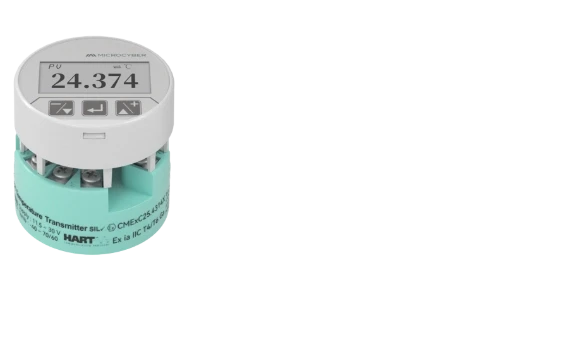
Real-world example: The Microcyber NCS-TT106H is a perfect single-channel smart HART temperature transmitter. It supports 8 thermocouple types (B, E, J, K, N, R, S, T), 4 RTD types (PT100, PT1000, CU50, CU100), resistance, and mV signals — all on one device. It offers ±0.15°C accuracy for PT100, one-click 2-wire zero calibration, and works in both 4-20mA compatible mode and full HART multidrop networking (up to 64 devices).

What Are the 4 Types of Temperature Sensors Used with HART Transmitters?
Although there are dozens of temperature sensing technologies, industrial HART transmitters are most commonly paired with these four main types:
- RTD (Resistance Temperature Detector) — Most accurate and stable
Best choice for precision applications (-200°C to +850°C). PT100 and PT1000 are the most popular. The NCS-TT106H supports 2-, 3-, and 4-wire RTDs with automatic lead compensation. - Thermocouple (TC) — Widest temperature range and fastest response
Uses two dissimilar metals to generate a tiny voltage. The NCS-TT106H supports 8 types (B, E, J, K, N, R, S, T) with automatic cold-junction compensation (±0.5°C accuracy). - Thermistor — High sensitivity at lower temperatures
Not as common in heavy industry but used in HVAC and laboratory applications. Some HART transmitters can accept thermistor curves via resistance input. - Semiconductor / IC Sensor — Low-cost, linear output
Digital output (I²C, SPI) or analog voltage. Increasingly used in smart buildings and IIoT, though less common in harsh process environments compared to RTDs and TCs.
In practice, 95% of industrial HART temperature transmitters are used with either RTD or Thermocouple sensors.
How Does a Smart HART Temperature Transmitter Actually Work in the Field?
Step-by-step real-world operation:
- The sensor (RTD or TC) sends a raw signal to the transmitter.
- The microprocessor linearizes, compensates, and converts it to a precise temperature value.
- The transmitter outputs a 4-20mA signal proportional to the temperature (4mA = lower range, 20mA = upper range).
- At the same time, HART digital packets travel over the loop for configuration and diagnostics.
You can use a HART communicator, laptop with HartMPT software, or any modern asset management system to:
- Change the 4-20mA range without touching wires
- Set damping time
- Configure high/low alarms (21.75–23mA or 3.5–3.75mA)
- Perform one-click zero calibration on 2-wire RTDs
Why Choose a Smart HART Temperature Transmitter Like the NCS-TT106H?
Modern plants choose smart HART transmitters because they deliver:
- Lower installation and maintenance cost (same two wires carry everything)
- Better accuracy and stability (±0.15°C for PT100)
- Remote diagnostics that reduce unplanned downtime
- Future-proofing (easy integration with IIoT and digital twins)
- Wide operating range (-40°C to +85°C ambient)
The Microcyber NCS-TT106H is an excellent example: ultra-compact Φ45×23mm head-mounted design, IEC61158-2 bus cable compatibility, 1000VAC isolation, and full support for both 4-20mA and multidrop HART networking.
Common Questions Engineers Still Ask
Q: Can I use a HART transmitter in a pure 4-20mA system?
A: Yes — it works exactly like a traditional transmitter. The digital HART layer is simply ignored.
Q: Do I need special cable for HART?
A: Use shielded twisted-pair cable per IEC61158-2 for best performance, but standard instrument cable often works for short runs.
Q: How many devices can share one HART loop?
A: In multidrop mode (digital only), up to 64 devices with unique addresses 0–63. In normal 4-20mA mode, only one device per loop.
Final Thoughts: Is a Smart HART Temperature Transmitter Right for Your Plant?
Whether you are upgrading an old analog system or designing a new greenfield project, a smart HART temperature transmitter offers the perfect balance of proven analog reliability and modern digital intelligence.
 English
  Русский
  Español de México