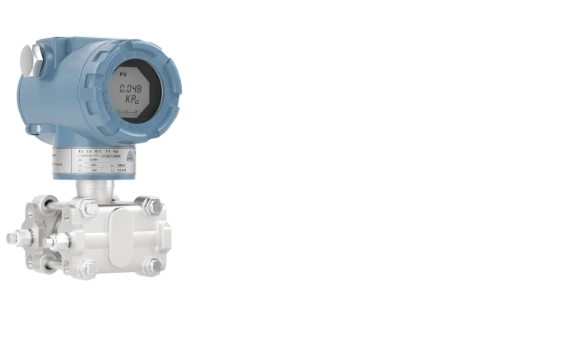
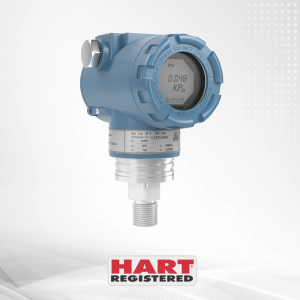
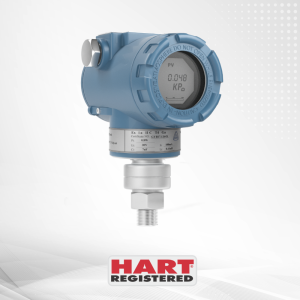
Microcyber’s Monosilicon Pressure Transmitters represent the next evolution in industrial sensing technology. By utilizing a suspended Single Crystal Silicon sensor die, these instruments achieve a level of accuracy and stability that outperforms traditional capacitive or piezoresistive technologies.
Designed for the most demanding process environments, our Monosilicon series features:
Superior Stability: Minimal drift over time, reducing calibration frequency.
High Overload Capability: Excellent resistance to pressure spikes and water hammer effects.
High Accuracy: Precision measurement for critical flow, level, and pressure applications.
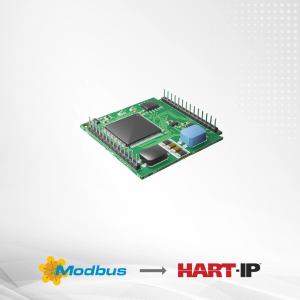
Combined with Microcyber’s certified HART, Foundation Fieldbus, and Profibus-PA protocol stacks, these transmitters deliver both the ruggedness required by the field and the intelligence required by your control system.
What is a Differential Pressure (DP) Level Transmitter?
A Differential Pressure (DP) level transmitter is an industrial instrumentation device used to measure the liquid level inside a vessel by detecting the difference in hydrostatic pressure between two distinct points (typically the top and bottom of the tank). While it can be used for open tanks, a DP level transmitter is especially critical for pressurized or sealed vessels, where total pressure includes both the liquid heads and the blanket gas pressure.
How does a DP pressure transmitter work?
A DP transmitter operates by translating physical pressure differences into a standardized electrical signal (typically 4-20 mA, HART, or Profibus) through the following core mechanism:
The Sensing Diaphragm: The transmitter features two process connections—a High-Pressure (HP) port and a Low-Pressure (LP) port. Pressures from these two points act on opposite sides of an internal, flexible metal sensing diaphragm.
Mechanical Displacement: The diaphragm flexes toward the side with lower pressure. The displacement distance is directly proportional to the differential pressure ($\Delta P$).
Signal Conversion: This micro-movement is detected by internal sensors, typically using one of two technologies:
Capacitive sensors: Measure the change in capacitance between the flexing diaphragm and fixed capacitor plates.
Piezoresistive sensors: Detect the change in electrical resistance caused by the physical strain on the material.
Electronic Processing: Onboard electronics linearize the raw sensor data, apply temperature compensation, and output a stable, standardized signal to your control system (PLC/DCS).
How do you calculate DP level? (DP Level Formula)
To determine the actual liquid level, the transmitter calculates the Differential Pressure ($DP$) or Process Variable ($PV$) using the specific gravity ($S.G.$) of the process fluid.
The fundamental calculation formula is:
$$DP = (HP \times S.G.) – (LP \times S.G.)$$
Note: When configuring level measurements, you must account for the density of the liquid and the installation setup. For instance, in closed tanks, the low-pressure side (LP) is connected to the top vapor space to cancel out the tank’s internal blanket pressure, ensuring that only the liquid’s hydrostatic head pressure is measured.
What are the common industrial applications of DP Transmitters?
Differential pressure transmitters are highly versatile process instruments used across various applications:
Level Measurement: Real-time monitoring of liquid volume/height in open, closed, or highly pressurized storage tanks.
Flow Measurement: When paired with a primary element (such as an orifice plate, Venturi tube, or Pitot tube), it measures the pressure drop across the restriction to calculate the fluid flow rate.
Filter Monitoring: By measuring the pressure differential before and after a fluid filter, it monitors the clogging status and alerts operators when filter elements need maintenance or replacement.